


By Dr. Atif Ansar
Last month, I sat down with Candace Sipos at JSA-TV during DCD Virginia, and she asked me a question that cuts to the heart of what’s changing in our industry: “Are we entering an era where investors value how fast you can deliver more than how much you can actually build?”
My answer was immediate: Absolutely.
But the more interesting question is why this shift is happening now—and what it reveals about the maturation of data center delivery.
The Economics of Lost Time
Let me start with the numbers, because they matter.
For a 100-megawatt data center, opening on time means you begin generating approximately $15 million in revenue on day one. If you’re late, that revenue doesn’t shift to next quarter—it vanishes entirely. In the 15-year lease structures common to our industry, every month of delay erases revenue that will never be recovered.
But the visible revenue loss is only the beginning. Research by STL Partners demonstrates that a three-month delay can fundamentally alter the internal rate of return on a 15-year project. Beneath the surface sits what I call the “delay iceberg”: financing costs that continue accruing, inflation that compounds, idle equipment depreciating, standing armies of personnel waiting, and management bandwidth consumed by coordination failures rather than value creation.
For that same 100-megawatt facility, you’re looking at roughly $15 million in lost revenue plus an equal amount in delay-related costs. A single quarterly slip likely costs $30 million in total economic impact.
This is why the industry’s optimization function has fundamentally changed. We used to optimize for cost control. But when time itself becomes the binding constraint—when speed to market determines whether you capture demand or lose it—the entire calculation shifts.
Time has become a form of capital. And like any form of capital, it can be deployed wisely—or squandered.
The Governance Gap
What fascinates me is not just that this shift is happening, but how organizations are responding to it.
Six months ago, construction schedules were operational details, delegated to heads of construction who managed delivery largely independently. The C-suite focused outward: on investors, on customers, and on raising and deploying capital.
That model no longer works at the scale and speed AI demand requires.
The best-performing platforms have instituted monthly business reviews where the CEO, COO, and chief revenue officer sit down with heads of construction and project directors to examine what’s actually happening on site. Not high-level dashboards. The ground truth.
This wasn’t standard practice six months ago. Now it’s the norm among the best-run platforms.
And investors are watching closely. Platforms that operate with numerical discipline command premium valuations because they treat delivery timelines as strategic assets. Meanwhile, platforms with less rigorous time discipline face increasing scrutiny.
The Blackstones and MGXs of the world have shifted their due diligence focus to not just financial discipline, but time discipline—the organizational capability to deliver infrastructure predictably, at scale, under pressure.
Speed to market is no longer a differentiator. It’s a prerequisite for institutional capital.
When Markets Punish Optimism
It was impossible to ignore what happened at CoreWeave last month.
Despite posting an impressive quarter—$1.4 billion in Q3 revenue, a backlog surging past $55 billion, demand that by all accounts remains robust—the company revised its full-year guidance down by roughly $200 million. All because of a delay at a single third-party data center provider.
The market’s response was immediate and unforgiving: CoreWeave’s stock fell nearly 21% in a single day. More than $24 per share was erased in the hours following the earnings call—not because customer demand had weakened, but because delivery timelines had slipped.
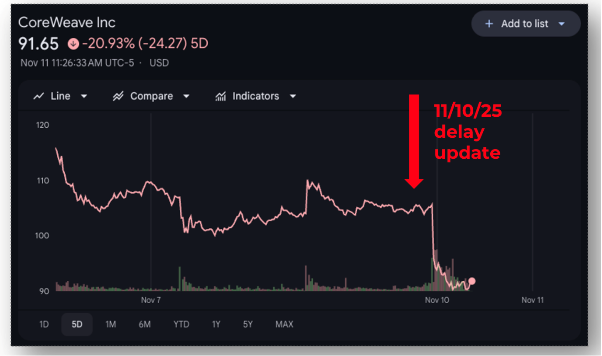
CEO Michael Intrator explained that infrastructure scheduled for Q4 would now come online in Q1, with some extending into Q2. He described it as a temporary setback, saying: “This delay will clear itself, and the infrastructure will be deployed.”
But here’s where my years of experience and research lead me to respectfully disagree: delays don’t clear themselves.
Delays are symptomatic. They reveal fragmented information flows, optimism bias in planning systems, coordination failures across trades, and a persistent gap between what developers believe is happening and what’s actually unfolding onsite.
Once a delay surfaces, it rarely resolves through passive waiting. It requires active intervention, root-cause diagnosis, and often painful organizational recalibration.
This pattern isn’t unique to CoreWeave—it’s endemic to an industry building at unprecedented scale. As Intrator noted, “Getting a data center online is difficult.” He’s right. And that difficulty is precisely why organizational discipline around delivery has become a defining characteristic of successful platforms.
The Maturation Thesis
So, why is this shift happening now?
I believe we’re witnessing the maturation of data center delivery from a frontier market—characterized by high growth and operational improvisation—to an institutional asset class that demands predictability and systematic risk management.
In frontier markets, speed and aggression win. But as markets mature, institutional capital optimizes for downside protection. Pension funds, sovereign wealth, and infrastructure investors will accept lower expected returns in exchange for tighter probability distributions around those outcomes.
This is what’s driving the governance restructuring we’re seeing. CEOs can’t afford to be surprised anymore. Real-time visibility into project health isn’t a dashboard feature—it’s essential infrastructure for decision-making under uncertainty.
Giving Thanks
Before I close, I want to acknowledge something that often gets lost in discussions about timelines, schedules, and financial returns: the extraordinary effort this work requires from the people who do it. For our colleagues and partners in the United States who recently celebrated Thanksgiving, I hope you found time to step back and recharge.
As we head into the final weeks of the year, the pace of this industry shows no signs of slowing. However, the questions we’re wrestling with today will only sharpen in 2026: How do we build faster without breaking? How do we turn speed into a discipline rather than a gamble? And, finally, if time has become the currency of this industry, how do we spend it wisely?
I’d welcome your thoughts. Let’s keep the conversation going.
— Atif
This article is part of a thought leadership series by Dr. Atif Ansar. Subscribe to receive future posts. Read last month’s article here.